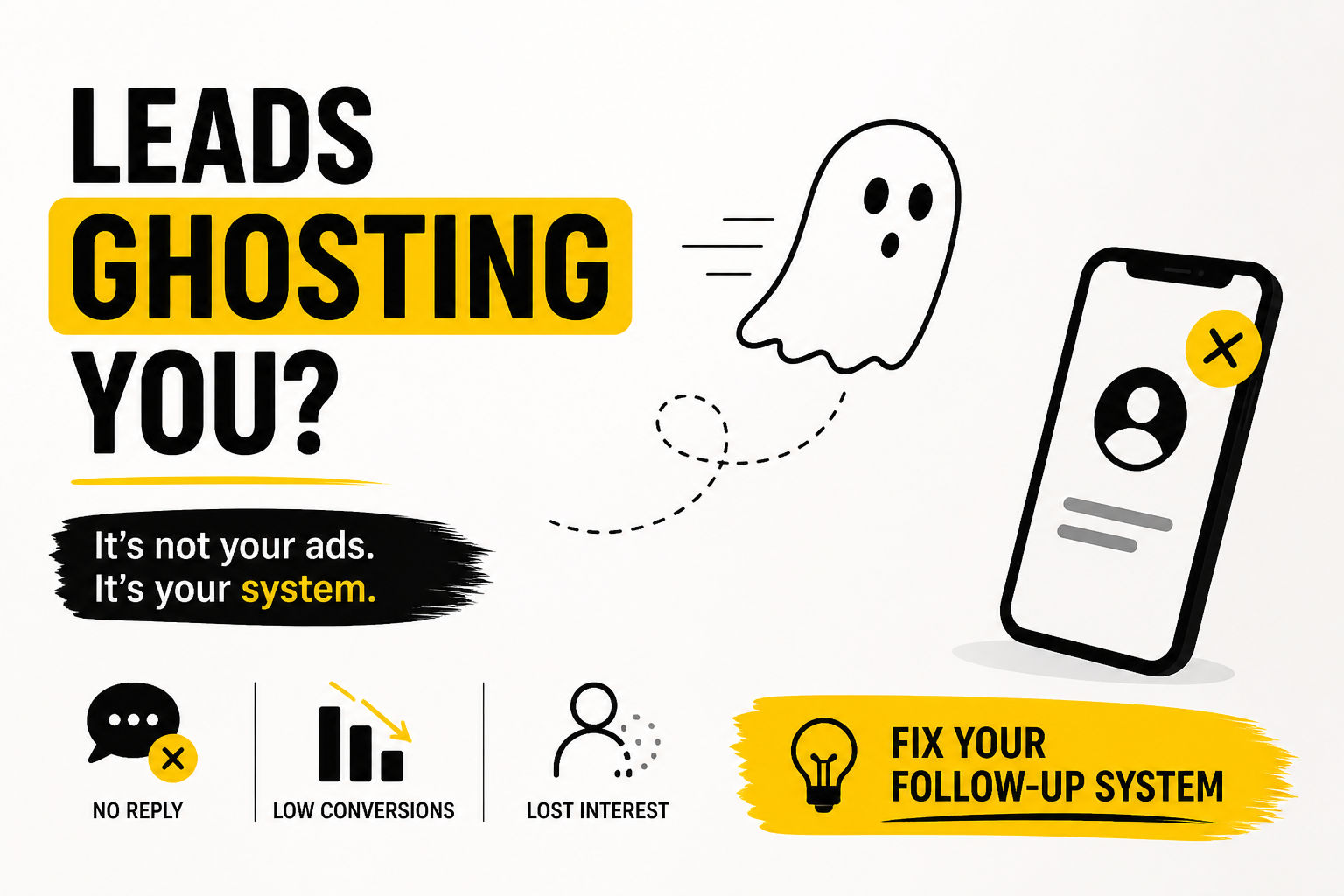
Lead follow up system failures are the real reason
prospects go silent after showing interest — not
The leads themselves.
You ran ads, got clicks, and leads showed interest,
then suddenly they stop responding. No reply.
No callback. Just silence.
This isn’t random ghosting. It’s a breakdown in your lead follow up system.
In this article, you’ll understand why leads stop responding and how to fix your system so they convert instead of disappearing.
Buyers Make Their Decision Before You Know They Exist
Most businesses think the sales process starts when a lead fills out a form. It doesn’t.
By the time a buyer reaches out, they’ve already researched, built a shortlist, and formed a preference without telling you. Buyers are roughly 70% through their decision before making first contact.
PRO TIP: The form fill isn’t the start of your sales process. It’s the end of theirs.
Your lead follow up system needs to be active
before the form fill — not just after it.
If your marketing isn’t working during those early stages, you’re not even in the conversation; you just don’t know it yet.
Buyers Research You Silently Long Before They Reach Out
Think about how you make a big purchase. You don’t call the company first. You Google them, read reviews, compare options, and form an opinion.
Your buyers do the same thing.
They visit your website at 11 pm. They read your case studies, or notice you don’t have any. They check if your content answers their questions or just talks about how great you are.
Buyers spend only about 17% of their total buying time actually talking to vendors.
The other 83%? They’re figuring it out alone, with or without your help.

Why Prospects Stop Responding
Here’s what actually happens when a lead disappears after showing interest.
They didn’t lose interest. They kept researching, and a competitor answered their questions more clearly than you did.
Or they couldn’t find basic information, pricing, results, or how it works, and instead of asking, they just left.
Ghosting is rarely personal. It’s logical.
A strong lead follow up system removes the guesswork
By answering buyer questions before they ask them.
Buyers want clear answers to:
- What does this roughly cost?
- What results should I realistically expect?
- Has this worked for a business like mine?
If your content doesn’t answer these, you’re making them work too hard. And they won’t.
What Most Businesses Get Wrong
- They chase more leads instead of fixing the conversion
- They rely on ads instead of building trust
- They hide pricing and expect leads to ask
- They treat every lead like they’re ready to buy
Most businesses don’t have a lead problem. They have a system problem.
And that system problem always starts with a broken
lead follow up system that chases instead of nurtures.
Most Businesses Try to Capture Leads Before Earning Their Trust
There’s a difference between creating demand and capturing leads.
- Capturing leads – ads, form fills, pushing people to book a call, only works on people already ready to buy.
- Creating demand – educating, answering questions, building trust early, is what makes buyers choose you before they even contact you.
Most businesses skip the first step entirely. They collect leads who aren’t ready, push them to sales too soon, and wonder why nothing converts.
Do both. But in the right order.
The right order is what separates a working lead
follow up system from one that just creates noise.
The Fix Is a Better Lead Follow Up System — Not a Better Ad
A better subject line won’t fix ghosting. Neither will a shorter form nor a new ad creative.
Those are tactics. Tactics can’t fix a broken system.
What actually works:
- Your website answers real questions, not just what you offer, but proof that it works
- Your content exists for people still in research mode, not just ready-to-buy leads
- Your follow up speaks to where the buyer actually is, not a generic “just checking in.”
- You stop treating every form fill as a hot lead
The goal isn’t more leads. It’s leads that already trust you when they arrive.
That’s what a properly built lead follow up system
delivers — trust before the conversation even starts.
How to Fix Your Lead Follow-Up System in 5 Steps
1. Add Pricing Clarity
Buyers who can’t find pricing don’t ask — they leave. Give a range, a starting point, or a “from” price. Remove the friction before it kills the conversation.
2. Show Real Proof Through Case Studies
Generic testimonials don’t convert. Specific results do. Show a business like theirs, with a problem like theirs, and the outcome you delivered.
3. Create Content for Decision-Stage Buyers
Most content attracts researchers. Write for buyers who are comparing options and need one final reason to choose you — not an explanation of what you do.
4. Build a Structured Follow Up Sequence
Random “just checking in” calls don’t work. A lead follow up system means defined touchpoints — day 1, day 3, day 7 — each adding value, not just chasing.
5. Align Messaging With Where the Buyer Actually Is
A lead who just found you needs education. A lead who visited your pricing page needs a nudge. Same message to both = low conversion. Match the message to the moment.
The Bottom Line
Lead quality is rarely an ad problem. It’s a system problem.
Fix the system. Answer the hard questions upfront. A proper lead follow up system does this automatically, so no lead slips through the cracks again. Be present during 83% of the journey that happens before buyers contact you.
Your best leads aren’t ghosting you because they don’t care.
They’re ghosting you because by the time you reached out, they had already decided, and your marketing wasn’t there when it mattered.


